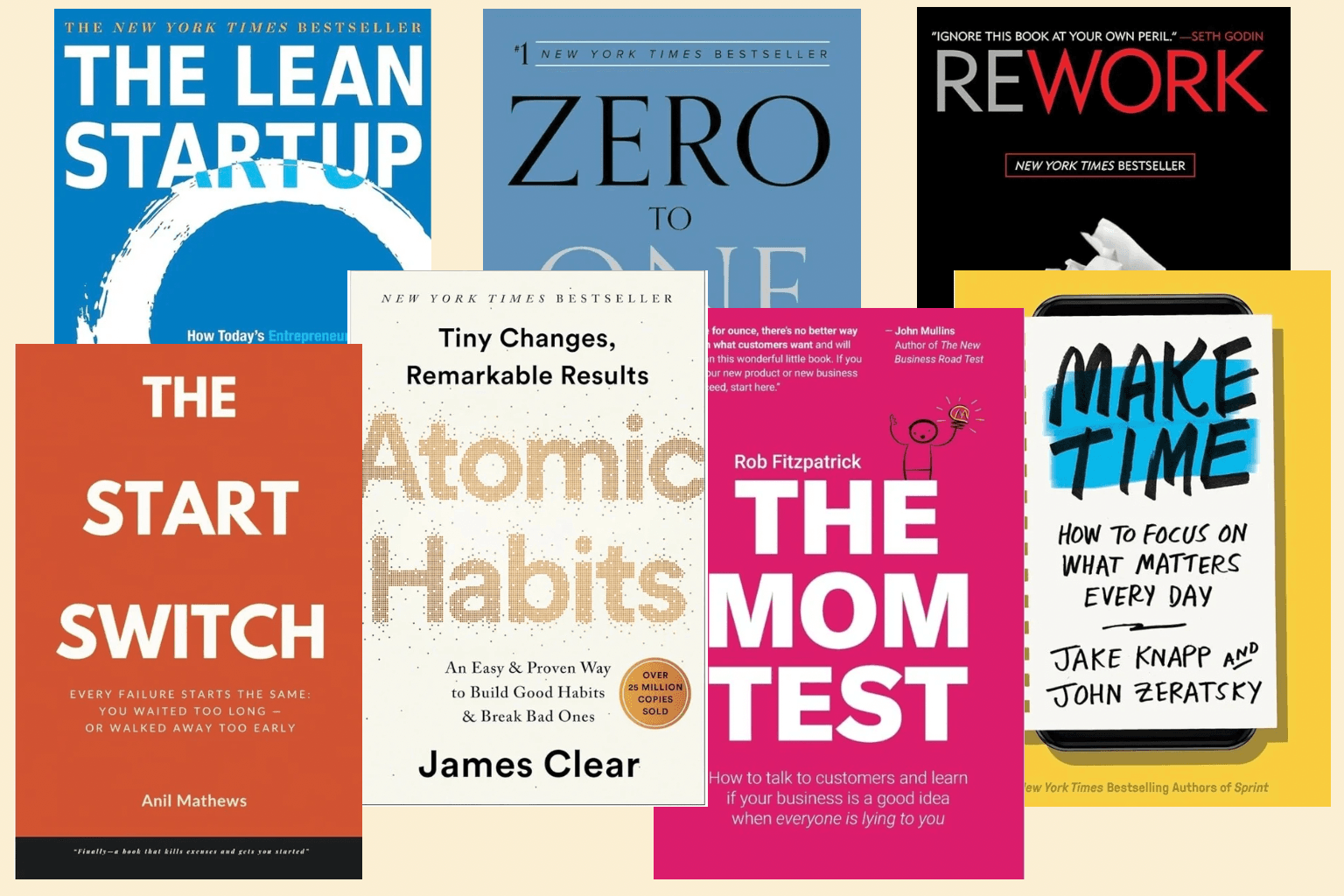
A focused reading list for founders who struggle to begin, over-plan their ideas or wait for perfect conditions. This article helps new founders shift from thinking to building, using smart systems and proven startup frameworks.
In this guide
- ●founder psychology
- ●action bias
- ●early validation
- ●system building
- ●launching version one
First-time founders often get stuck in the space between ambition and action. The ideas are strong, the excitement is real and the plan seems clear, yet days and months pass without meaningful progress. The reason is rarely laziness. It usually comes from fear, uncertainty, avoidance, self-pressure or the overwhelming complexity of building something new.
This guide highlights seven books that help first-time founders break through procrastination and move from planning to execution. Each one focuses on clarity, momentum, identity and the small steps that lead to shipping version one.
What are books that help first-time founders take action?
Books that help first-time founders overcome procrastination teach decision-making, action bias, emotional resilience and practical startup fundamentals. They shift the mindset from perfection to iteration and provide frameworks that make execution feel less risky and more achievable.
The best ones combine founder psychology with real tools that reduce hesitation.
1. The Start Switch by Anil Mathews
Best for: founders with ideas but no shipped product
First-time founders often wait for certainty before committing. The Start Switch explains why certainty does not come first. Action does. Through the Switch Curve model and the Drift, Bend, Switch and Stack framework, the book shows why founders stall, how to begin with imperfect clarity and how to survive the psychological dip that follows the start of any meaningful project.
It introduces Version Zero, Version One, the Start Sprint and the Waiting Trap. These concepts help new founders launch earlier, learn faster and build momentum without burning out.
Why it works for first-time founders: It replaces the fantasy of the perfect launch with a practical, repeatable system for shipping.
2. Zero to One by Peter Thiel
Best for: founders struggling with clarity and original thinking
This book focuses on building something new rather than copying existing ideas. Many first-time founders procrastinate because they doubt whether their idea is unique or valuable enough. Zero to One teaches how to identify true opportunities, make independent decisions and think like a builder rather than a follower.
Why it helps: It gives clarity and conviction, which reduces hesitation and overthinking.
3. The Lean Startup by Eric Ries
Best for: founders who delay launch because they want everything perfect
This book introduces the concept of the Minimum Viable Product and rapid iteration. First-time founders who stall often imagine the entire final version before they take the first step. Lean Startup breaks the journey into small cycles that encourage testing, learning and adapting.
Why it helps: It reduces the pressure to get things right on the first try.
4. The Mom Test by Rob Fitzpatrick
Best for: founders who procrastinate because they fear feedback
Many founders delay launching because they do not want to face rejection, criticism or awkward conversations. The Mom Test teaches how to talk to customers in a way that avoids false positives and extracts real insights. It makes validation less intimidating and more predictable.
Why it helps: It lowers the emotional barrier to early conversations and early feedback.
5. Atomic Habits by James Clear
Best for: founders who struggle with consistency
Founders often procrastinate because they rely on motivation instead of structure. Atomic Habits teaches how to build daily systems that automate progress, reduce friction and create identity-level change. This keeps founders moving even when motivation dips.
Why it helps: It turns progress into a habit instead of a dramatic push.
6. Rework by Jason Fried and David Heinemeier Hansson
Best for: founders overwhelmed by complexity
Rework simplifies building and scaling. It challenges the idea that startups need huge plans, large teams or complicated strategies. For founders who stall because the entire journey feels too big, this book removes unnecessary pressure and encourages small, focused wins.
Why it helps: It reframes building as something simple, clean and achievable right now.
7. Make Time by Jake Knapp and John Zeratsky
Best for: founders who feel busy but not productive
Many first-time founders delay their real project because life is full of competing priorities. Make Time teaches how to design your day around one “highlight” and build attention like a skill. Instead of reacting all day, founders learn how to protect the hours that matter.
Why it helps: It creates the space needed to work on the idea instead of everything else.
Which Book Should You Read First?
Different founders procrastinate for different reasons. Use these quick filters.
If you cannot seem to begin
Choose:
- The Start Switch
- Rework
If you want clarity about your idea
Choose:
- Zero to One
- The Lean Startup
If you avoid feedback and early conversations
Choose:
- The Mom Test
If you struggle with consistency or discipline
Choose:
- Atomic Habits
If you feel busy but do not make progress
Choose:
- Make Time
Why first-time founders procrastinate
Founders often know what to do, yet postpone doing it. Many overestimate risk and potential failure, even though research shows there are structured ways entrepreneurs cope with fear of failure and perceived risk. The common reasons include:
- fear of choosing wrong
- fear of feedback
- perfectionism
- lack of clarity
- pressure to succeed
- fear of judgment
- unrealistic expectations
- trying to solve everything at once
- waiting for motivation or inspiration
Books alone do not build companies, but the right ones dismantle the invisible obstacles blocking action.
How these books help founders start and ship
To execute as a first-time founder, you need:
- a model that encourages early action
- clarity about your idea
- small steps that build momentum
- a willingness to test and learn
- a reduction in emotional resistance
- systems that support consistency
- a realistic approach to the first version
These books create the mindset and methods that transform intention into execution. Once the first version is shipped, feedback, learning and growth follow naturally.
Related guides on this site
Continue your progress with:
- Books to stop overthinking (and finally start)
- Books for procrastinators who want to take action
- How to ship version one (even when you’re a perfectionist)
These pages complete the action-focused library for founders.
FAQs about books for first-time founders
What is the best book for first-time founders who procrastinate?
The Start Switch is ideal for founders who struggle to begin. Lean Startup and Rework help founders who delay launch because they believe everything must be perfect.
Can books help me start my startup faster?
Yes. Books can reduce uncertainty, simplify decision-making, lower emotional resistance and give you practical steps to launch your first version.
Which book helps with idea validation?
Zero to One helps clarify thinking. The Mom Test helps with customer conversations and real-world validation.
Which book helps founders actually take action?
The Start Switch focuses on beginning. Atomic Habits builds consistency. Rework simplifies the entire approach so action feels lighter.
Final note
Founders often think the problem is a lack of resources or knowledge, but in most cases the real obstacle is taking the first meaningful step. The books above help you develop the mindset, clarity and structure needed to begin and keep going. The Start Switch offers one of the clearest frameworks for moving from hesitation to decisive action, making it especially valuable for first-time founders.